Mitchell Starc Takes 6 for 72 to Break Shane Warne’s 24-Year Newlands Record With Four Wickets in Six Balls
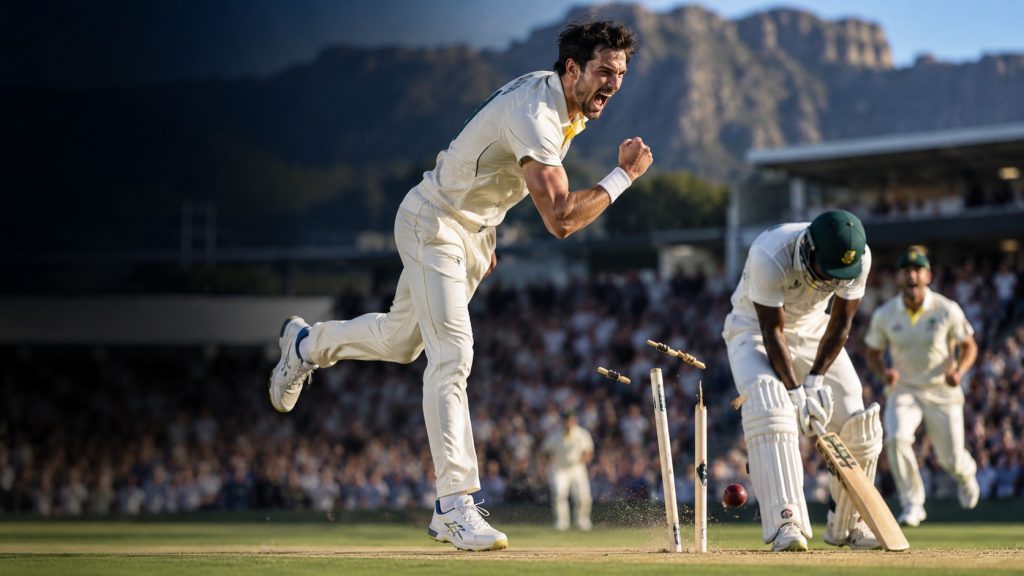
Mitchell Starc produced a remarkable late spell of fast bowling to rewrite Australia’s Test record books on October 27, 2026, helping dismiss South Africa for 329 on the opening day of the third Test at Newlands in Cape Town. The left-arm quick finished with figures of 6 for 72, surpassing Shane Warne’s 24-year-old record for the best bowling figures by an Australian in a Test innings at the venue.
Starc’s performance was defined by an extraordinary burst in which he claimed four wickets in six deliveries. South Africa had appeared well placed to post a commanding first-innings total, but the Australian fast bowler’s accuracy, pace and late movement transformed the contest and gave his team a crucial lift in the series-deciding match.
Mitchell Starc Surpasses Shane Warne’s Newlands Record
Before Starc’s performance, Shane Warne held the record for the best innings bowling figures by an Australian in a Test match at Newlands. The legendary leg-spinner took 6 for 161 at the ground in 2002, a mark that had stood for 24 years.
Starc bettered that performance with 6 for 72 from 16.3 overs, including two maiden overs. Although both bowlers took six wickets, Starc conceded 89 fewer runs than Warne, underlining the effectiveness of his spell.
The achievement was venue-specific: Starc set a new benchmark for Australian bowlers at Newlands rather than breaking an overall record for the best bowling figures in Test cricket. His six-wicket haul also marked his 20th five-wicket haul in Test cricket, adding another milestone to an accomplished international career.
Four Wickets in Six Balls Turn the Match Around
South Africa’s innings began with a strong display from openers Aiden Markram and Marques Ackerman. The pair combined for 158 runs for the first wicket, putting the hosts in control after Australian captain Pat Cummins elected to field first.
Ackerman scored 95, narrowly missing a maiden Test century, while Markram contributed 78. After their opening partnership ended, Australia gradually found ways to break through. David Bedingham added 50, but the hosts struggled to maintain their earlier momentum as the innings progressed.
Starc first made a significant impact by removing Bedingham and Wiaan Mulder during Australia’s successful short-ball approach. He returned to deliver an even more decisive blow with the second new ball.
Ryan Rickelton, who scored 42, was dismissed leg before wicket, while Marco Jansen fell for 52 after contributing to a 95-run seventh-wicket partnership. Starc then bowled Gerald Coetzee for a duck before trapping Kagiso Rabada leg before wicket, completing the remarkable sequence of four wickets in six balls.
The late collapse left South Africa all out for 329 in 82.3 overs. After building a position of 327 for six, the hosts lost their remaining wickets in a dramatic finish that handed Australia renewed momentum.
South Africa’s Batting Effort Ends in Frustration
Despite the collapse, South Africa produced several important contributions. Ackerman’s 95 and Markram’s 78 established the innings, while Bedingham’s half-century and Jansen’s 52 helped the team recover after losing wickets in the middle session.
However, Australia’s bowlers found their rhythm as the innings approached its conclusion. Starc’s ability to exploit the second new ball proved decisive, particularly after the South African lower order had appeared capable of adding valuable runs.
Starc’s six wickets included Bedingham, Mulder, Rickelton, Jansen, Coetzee and Rabada. Nathan Lyon also played a key role, claiming two wickets, while Josh Hazlewood and Cooper Connolly took one each.
Australia vs South Africa: Latest Test Match Update
The third Test is the decisive match of the three-Test series, which was level at 1-1 entering the fixture. Australia won the opening Test in Durban by 214 runs, while South Africa responded with an innings-and-31-run victory in Gqeberha.
In the latest verified live update available for October 28 at 9:20 p.m. Indian Standard Time, Australia had reached 312 for four in their first innings, trailing South Africa’s total of 329 by 17 runs. The innings was still in progress at that update, with Josh Inglis and Alex Carey batting.
The result of the third Test will determine the series winner and could also have implications for the teams’ positions in the World Test Championship standings. Australia will aim to build on Starc’s late bowling performance, while South Africa will look to take wickets and regain control.
Why Starc’s Performance Matters
Starc’s spell combined a major venue record with a match-changing sequence of wickets. His 6 for 72 surpassed Warne’s long-standing Newlands benchmark, while the final four wickets in six deliveries ensured South Africa could not turn a promising start into a substantially larger total.
For Australia, the performance offered an important response after the hosts’ dominant opening partnership. For Starc, it was another demonstration of his ability to change a Test match through sustained pace, intelligent adjustments and precision with the new ball.
With the series finely poised, Starc’s performance has given Australia a significant talking point in Cape Town. The challenge now is to convert that late first-day breakthrough into an advantage across the remainder of the deciding Test.

Recommended News

Shadman Islam Stranded on 99 as Bad Light Ends...

Sanju Samson’s No. 3 Sacrifice for Vaibhav Sooryavanshi: One...

The “Chocolate” Strategy Explained: Why Former Cricketer Sadagopan Ramesh...

Two Office Workers Go Viral After Hilarious SA vs....

CSK Fans Embrace ‘Thala Retained’ Chatter, but MS Dhoni’s...

The ‘Telugu Brothers’ Era: How Tilak Varma and Nitish...
Devdutt Padikkal’s Frustrated Reaction to 199-Run Dismissal Sparks Umpiring...